

AI Agents vs Chatbots
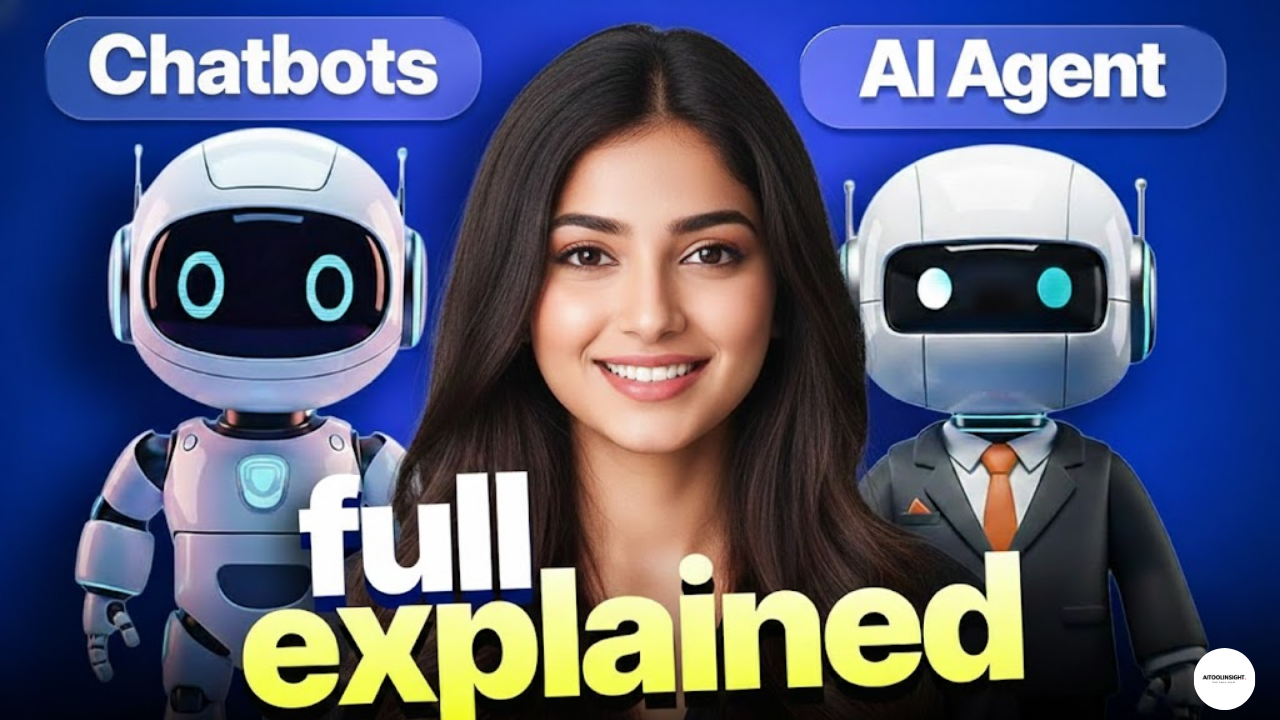
The comparison between AI agents vs chatbots highlights a critical evolution in artificial intelligence systems. While chatbots are designed for conversation, AI agents operate as goal-driven entities capable of planning, tool usage, and execution, a distinction central to AI Agents Explained. This difference becomes especially visible when examining what AI agents can do today in complex operational workflows.
The limitations of chatbots become more apparent as organizations adopt AI agent automation to manage tasks end to end rather than respond to isolated inputs. Concerns around consistency and accuracy also make AI agent reliability a key factor in this comparison. These contrasts are best understood through real examples of AI agents already deployed across industries.
AI Agents vs Chatbots: Comparison Table
| Aspect | AI Agents | Chatbots |
|---|---|---|
| Core Purpose | Execute tasks and achieve goals | Respond to user queries |
| Behavior Model | Action-driven and goal-oriented | Interaction-driven and reactive |
| Persistence | Operates continuously over time | Ends when conversation ends |
| Autonomy Level | Semi-autonomous to bounded autonomous | Minimal or none |
| Decision-Making | Chooses actions based on goals and context | Chooses responses only |
| Tool Usage | Central to execution and workflows | Optional and limited |
| Ownership of Outcomes | Yes — responsible for task completion | No — responsibility stays with user |
| Failure Handling | Retries, adapts, escalates | Explains error or asks for clarification |
| Memory Usage | Structural (state, progress, history) | Contextual and short-term |
| Typical Use Cases | Automation, orchestration, monitoring | Q&A, support, assistance |
| Risk Profile | Medium to high (requires governance) | Low (easy to control) |
| Human Oversight | Explicit and required | Implicit and optional |
| Scalability | Slower, governance-dependent | Fast and lightweight |
| Replacement Potential | Replaces execution work | Improves efficiency per task |
Why These Two Systems Are Constantly Confused — and Why the Difference Matters
AI agents and chatbots are often treated as interchangeable terms. In product marketing, technical discussions, and even enterprise planning, the distinction between the two is frequently blurred. This confusion is not accidental. Modern chatbots use advanced language models, while AI agents often expose conversational interfaces. On the surface, they can look similar.
But structurally and behaviorally, AI agents and chatbots serve fundamentally different roles.
Understanding this difference is not academic. It determines whether a system can merely assist a user or actually replace execution work.
Why the Confusion Exists in the First Place
The confusion between AI agents and chatbots comes from three overlapping trends:
- Chat interfaces became the default AI interaction model
- Language models improved faster than system architecture literacy
- Marketing labels outpaced technical accuracy
As a result, many systems that are still chatbots are marketed as agents, while some true agents are reduced to “advanced chatbots” in perception.
Chatbots Evolved First — Agents Came Later
Historically, chatbots came first.
Early chatbots:
- Responded to user input
- Followed scripted flows
- Had no memory or autonomy
Modern chatbots:
- Generate fluent language
- Handle complex queries
- Maintain short-term context
Despite these improvements, the core behavioral model has not changed.
A chatbot still waits.
An agent does not.
The Defining Question That Separates Agents From Chatbots
The most reliable way to distinguish an AI agent from a chatbot is to ask:
What happens when the user stops typing?
For a chatbot:
- Nothing happens
- The system is idle
For an AI agent:
- Work may continue
- Monitoring may persist
- Decisions may still be made
This single distinction reveals the entire structural difference.
Chatbots Are Interaction-Centered Systems
Chatbots are designed around interaction.
Their primary characteristics:
- User-initiated responses
- Short-lived context
- No responsibility for outcomes
Even advanced chatbots operate within a request–response loop. Once the interaction ends, so does the system’s role.
This makes chatbots excellent assistants—but poor executors.
AI Agents Are Execution-Centered Systems
AI agents are designed around outcomes.
Their defining characteristics:
- Goal persistence
- Continuous operation
- Action beyond conversation
Conversation may be one interface among many, but it is not central. An agent may never “chat” at all.
Why Language Ability Is a Red Herring
One of the biggest misconceptions is that better language equals agency.
Language models improve:
- Explanation quality
- Instruction following
- Conversational realism
But none of these create agency.
A chatbot can explain how to do something perfectly and still be incapable of doing it. An agent may communicate poorly and still execute flawlessly.
Responsibility Is the Invisible Divider
Chatbots offer suggestions.
AI agents take responsibility for execution.
Responsibility means:
- Tracking progress
- Handling failure
- Retrying or escalating
- Completing objectives
This responsibility fundamentally changes how systems must be designed, monitored, and governed.
Why This Difference Is Becoming More Important Now
As organizations move from AI assistance to AI automation, the chatbot model begins to break down.
Chatbots:
- Increase productivity per task
- Still require humans to execute
Agents:
- Remove tasks entirely
- Restructure workflows
This is why the distinction matters more now than ever before.
Mislabeling Chatbots as Agents Creates Real Risk
When chatbots are mistaken for agents:
- Autonomy is overestimated
- Reliability is misunderstood
- Failures surprise teams
This leads to fragile deployments and loss of trust in AI systems overall.
Why This Part Focuses on Confusion, Not Comparison Tables
Many articles attempt to explain “AI agents vs chatbots” using feature tables.
This article does not.
Tables hide the real difference, which is behavioral and architectural, not cosmetic.
Structural Differences — Architecture, State, and Persistence
Once the surface-level confusion is removed, the real distinction between AI agents and chatbots becomes structural. These systems are built differently because they are designed to solve different classes of problems. No amount of prompting or interface enhancement can turn a chatbot into an agent without rearchitecting the system beneath it.
This part focuses on architecture, state management, and persistence—the foundations that determine how each system behaves.
Why Structure Determines Capability
Behavior is an outcome of structure.
Chatbots behave reactively because they are structured to respond. AI agents behave proactively because they are structured to operate.
This difference is not philosophical. It is architectural.
The Request–Response Architecture of Chatbots
Chatbots are built on a request–response loop.
The flow is simple:
- User sends input
- System generates output
- Interaction ends
Even advanced chatbots that maintain short-term context still rely on this loop. When the conversation stops, the system has no reason—or ability—to continue acting.
This architecture is efficient, scalable, and predictable, which is why chatbots are widely deployed.
Stateless vs Stateful Design
Most chatbots are fundamentally stateless.
They may:
- Remember context within a session
- Reference recent messages
But once the session ends, the system forgets.
State, in chatbot systems, is incidental—not foundational.
AI Agents Are Built Around Persistent State
AI agents require state to function.
State includes:
- Current objectives
- Progress markers
- Past decisions
- Environmental context
Without state, an agent cannot track progress or evaluate outcomes. Persistence is not an add-on; it is a prerequisite.
Why Persistence Changes Everything
Persistence allows agents to:
- Resume work after interruption
- Operate across long durations
- Coordinate multi-step processes
This is why agents can manage workflows that span hours or days, while chatbots cannot.
Control Loops vs Conversation Loops
Chatbots operate in conversation loops.
Agents operate in control loops.
A control loop includes:
- Observation
- Decision
- Action
- Evaluation
This loop repeats regardless of user interaction.
Conversation is optional. Control is mandatory.
Tool Integration as a Structural Difference
Chatbots may call tools, but tool use is peripheral.
In agents:
- Tools are central
- Actions depend on tool outcomes
- Failure handling is built in
Tool interaction is part of the agent’s control loop, not a side effect of a response.
Memory as an Architectural Component
In chatbots:
- Memory improves conversation quality
- Memory is ephemeral
In agents:
- Memory enables continuity
- Memory supports decision-making
This makes memory architectural in agents and cosmetic in chatbots.
Scheduling and Triggers
Chatbots cannot act without prompts.
Agents can:
- Respond to triggers
- Schedule actions
- Monitor conditions
This capability is impossible without persistent state and control loops.
Why You Cannot “Upgrade” a Chatbot Into an Agent
Adding:
- Better prompts
- More tools
- Longer context
Does not create agency.
Without:
- Persistent state
- Independent control loops
- Goal evaluation
A chatbot remains a chatbot.
True agents require a different system design.
Architectural Trade-Offs
Chatbots excel at:
- Scalability
- Predictability
- Low operational risk
Agents trade some of this simplicity for:
- Flexibility
- Persistence
- Execution power
Neither is inherently superior. They serve different purposes.
The Cost of Structural Complexity
Agents are harder to build and maintain.
They require:
- Monitoring
- Governance
- Error handling
- Resource management
This complexity is justified only when execution needs outweigh interaction needs.
Why Architecture Explains Reliability Differences
Chatbots rarely “fail” because they do not take responsibility.
Agents can fail because they act.
Understanding structure explains why agent reliability is a primary concern, while chatbot reliability is often ignored.
Behavioral Differences — Action vs Response, Initiative vs Interaction
With the structural differences established, the behavioral gap between AI agents and chatbots becomes clear. Even when both systems use similar language models and appear equally fluent, they behave in fundamentally different ways. These behavioral differences are not cosmetic. They define what kind of work each system can realistically replace.
This part focuses on how agents and chatbots behave once deployed, not how they are marketed.
The Core Behavioral Divide
At a behavioral level, the difference can be summarized simply:
- Chatbots respond
- AI agents act
Everything else flows from this distinction.
A chatbot’s behavior is bounded by interaction. An agent’s behavior is bounded by objectives.
Initiative vs Reactivity
Chatbots are reactive systems.
They:
- Wait for user input
- Respond when prompted
- Stop when interaction ends
Even proactive chatbots that send reminders still rely on predefined triggers. They do not decide whether something should be done—only how to respond once activated.
AI agents, by contrast, exhibit initiative.
They:
- Decide when action is required
- Initiate tasks without direct prompts
- Continue operating independently
Initiative is the behavioral hallmark of agency.
Execution Ownership
Chatbots provide guidance.
They:
- Explain steps
- Suggest actions
- Draft content
Ownership remains with the human.
AI agents take ownership of execution.
They:
- Perform actions
- Track progress
- Handle retries and failures
This shift in ownership is what allows agents to replace work rather than assist with it.
Persistence of Behavior
Chatbots behave episodically.
Each interaction is largely self-contained. Once the session ends, the system’s role concludes.
Agents behave persistently.
They:
- Maintain awareness over time
- Resume work after interruptions
- Monitor conditions continuously
Persistence enables long-running workflows that chatbots cannot sustain.
Adaptation vs Compliance
Chatbots comply with instructions.
If an instruction fails, the chatbot explains why or asks for clarification.
Agents adapt.
If an action fails, an agent:
- Modifies its approach
- Tries alternative tools
- Escalates when necessary
Adaptation is a behavioral necessity for execution-focused systems.
Handling Ambiguity
Chatbots often defer ambiguity back to the user.
They ask:
- “Can you clarify?”
- “What would you like to do next?”
Agents handle ambiguity operationally.
They:
- Make provisional decisions
- Use defaults and constraints
- Escalate only when necessary
This difference determines whether a system reduces workload or creates new questions.
Responsibility for Outcomes
Chatbots are judged by response quality.
Agents are judged by outcome quality.
If a chatbot gives a poor answer, the user corrects it.
If an agent fails, work does not get done.
This difference forces agents to behave conservatively and predictably.
Error Response Behavior
When errors occur:
Chatbots:
- Explain the error
- Suggest next steps
Agents:
- Attempt recovery
- Retry intelligently
- Change strategy
This behavioral difference makes agents more complex—but also more useful.
Behavioral Scope and Risk
Chatbots operate in low-risk behavioral zones.
They rarely:
- Change systems
- Trigger irreversible actions
- Affect other workflows
Agents operate in higher-risk zones because they act.
As a result:
- Their behavior must be constrained
- Their actions must be auditable
Why Fluent Language Masks Behavioral Limits
Modern chatbots sound intelligent because they communicate well.
This fluency often masks the fact that:
- They do not track progress
- They do not own outcomes
- They do not act independently
Agents may communicate less elegantly but deliver results consistently.
Human Perception vs System Reality
Humans often judge AI systems by conversational ability.
This leads to overestimating chatbots and underestimating agents.
Behavioral evaluation—what the system actually does—is a more reliable metric than conversational polish.
Why Behavioral Differences Matter for Automation
Automation requires systems that:
- Initiate actions
- Persist over time
- Adapt to failure
Chatbots improve efficiency per task.
Agents eliminate tasks entirely.
This distinction determines automation ROI.
Behavioral Drift and Control
Because agents act continuously, behavioral drift is a concern.
Effective agents:
- Monitor their own behavior
- Use feedback loops
- Stay within constraints
Chatbots do not drift because they do not persist.
Autonomy, Control, and Responsibility — Why Agents Require Governance and Chatbots Do Not
The moment a system moves from responding to acting, questions of autonomy, control, and responsibility become unavoidable. This is where AI agents and chatbots diverge most sharply—not in capability, but in risk profile and governance requirements.
This part explains why chatbots are comparatively easy to deploy safely, while AI agents demand structured oversight, constraints, and accountability frameworks.
Why Autonomy Changes the Risk Equation
Autonomy is not inherently dangerous. Uncontrolled autonomy is.
Chatbots operate with minimal autonomy:
- They respond when prompted
- They do not initiate actions
- They do not affect systems unless instructed
As a result, the consequences of chatbot errors are limited.
AI agents, however, operate with delegated authority. They make decisions and act on them. This introduces risk proportional to their scope.
The Relationship Between Autonomy and Responsibility
Autonomy and responsibility scale together.
If a system can:
- Trigger workflows
- Modify data
- Communicate externally
- Affect other systems
Then responsibility for outcomes must be clearly assigned.
This is why AI agents cannot be treated as “just smarter chatbots.” Their actions carry operational consequences.
Why Chatbots Rarely Need Governance Frameworks
Chatbots typically:
- Provide information
- Suggest actions
- Draft content
They do not own outcomes.
If a chatbot provides a bad suggestion, a human decides whether to act on it. Responsibility remains with the human.
As a result, chatbot governance focuses mainly on:
- Content safety
- Privacy
- Abuse prevention
Operational oversight is minimal.
Why AI Agents Demand Explicit Control Mechanisms
AI agents act directly.
This requires:
- Permission boundaries
- Action approval rules
- Escalation paths
- Auditability
Without these controls, agents can create cascading failures or unintended consequences.
Governance is not an add-on for agents. It is a core design requirement.
Approval Gates as a Control Pattern
One of the most common control mechanisms is the approval gate.
Approval gates:
- Allow agents to act freely within low-risk boundaries
- Require human confirmation for high-impact actions
This balances efficiency with safety.
Chatbots do not require approval gates because they do not execute actions.
Escalation as a Safety Valve
When agents encounter:
- Uncertainty
- Conflicting goals
- Incomplete information
They must escalate rather than guess.
Escalation paths ensure:
- Humans remain in control
- Errors are contained
- Trust is preserved
Chatbots rarely escalate because they defer by default.
Auditability and Traceability
Agent actions must be traceable.
Auditability includes:
- What action was taken
- Why it was taken
- Under which constraints
- With what outcome
This level of traceability is unnecessary for chatbots, which do not alter system state.
Why Responsibility Cannot Be Assigned to the AI
No matter how autonomous an agent is, responsibility remains human.
Humans:
- Define goals
- Set constraints
- Approve actions
- Own outcomes
AI agents execute within these boundaries. They do not bear accountability.
This distinction matters legally, ethically, and operationally.
Autonomy Does Not Mean Independence
A common myth is that autonomous agents operate independently of humans.
In practice:
- Humans design the system
- Humans monitor behavior
- Humans intervene when necessary
Autonomy refers to execution freedom, not decision ownership.
Why Over-Autonomous Agents Fail in Production
Agents given too much freedom:
- Accumulate small errors
- Drift from objectives
- Become unpredictable
These failures erode trust quickly.
Successful deployments prioritize controlled autonomy, not maximum autonomy.
The Cost of Governance Is the Price of Execution
Agents are more expensive to deploy than chatbots—not because of intelligence, but because of governance.
Costs include:
- Monitoring infrastructure
- Oversight processes
- Failure recovery mechanisms
These costs are justified only when agents replace meaningful execution work.
Why Chatbots Will Always Be Easier to Ship
Chatbots:
- Have lower blast radius
- Are easier to test
- Require fewer safeguards
This ensures chatbots remain popular for interaction-heavy use cases.
Agents, by contrast, are adopted selectively and deliberately.
Control as a Competitive Advantage
Organizations that design strong governance frameworks can deploy agents safely at scale.
Control becomes:
- A differentiator
- A trust signal
- A scaling enabler
Those without governance remain stuck at pilot stages.
Real-World Usage, Reliability, and Failure Patterns — Why One Replaces Work and the Other Assists It
When AI systems move from concept to deployment, the differences between AI agents and chatbots become impossible to ignore. Real-world environments expose reliability issues, failure modes, and operational limits that are rarely visible in demos. This part examines how chatbots and AI agents actually perform in production, and why their reliability profiles are fundamentally different.
How Chatbots Are Used in Real Operations
Chatbots are typically deployed where interaction quality matters more than execution accuracy.
Common characteristics of chatbot deployments:
- User-initiated conversations
- Short interaction windows
- Low operational risk
- Easy rollback and correction
If a chatbot makes a mistake, the cost is usually limited to confusion or extra clarification. Humans remain in control of outcomes.
Why Chatbots Are Naturally Reliable
Chatbots appear reliable because:
- They do not own execution
- They do not persist
- They do not modify systems independently
Their reliability comes from limited responsibility, not superior intelligence.
A chatbot that gives imperfect advice can still be “good enough” because the human filters and acts.
How AI Agents Are Used in Production
AI agents are deployed where execution consistency matters.
They are used to:
- Run workflows
- Coordinate systems
- Monitor conditions
- Execute follow-ups
In these roles, agents replace ongoing manual effort rather than assist it.
Why Reliability Is Harder for AI Agents
AI agents must be reliable because they act.
Reliability challenges include:
- Handling partial failures
- Recovering from tool errors
- Maintaining goal alignment
- Avoiding cascading mistakes
An agent that fails silently is worse than one that fails loudly.
Failure Looks Different for Agents and Chatbots
When chatbots fail:
- They give a wrong answer
- Users correct them
- Work continues
When agents fail:
- Tasks are incomplete
- Systems become inconsistent
- Humans must intervene reactively
This difference explains why agent failures feel more serious, even if they are less frequent.
Common Chatbot Failure Patterns
Typical chatbot failures include:
- Hallucinated explanations
- Overconfidence in uncertain answers
- Misinterpretation of intent
These failures are visible and usually correctable.
Common AI Agent Failure Patterns
Agent failures tend to be structural:
- Acting on outdated context
- Retrying ineffective actions
- Misinterpreting feedback signals
- Failing to escalate uncertainty
These failures accumulate over time if not detected.
Why Observability Matters More for Agents
Chatbots do not require deep observability.
AI agents do.
Operational agents must expose:
- Action logs
- Decision rationales
- State changes
- Error paths
Without observability, agents cannot be trusted.
Reliability Through Scope Control
The most reliable agents are narrowly scoped.
They:
- Have clear goals
- Limited tools
- Defined stop conditions
Broad agents amplify uncertainty and error.
Chatbots, by contrast, tolerate broad scope because they do not execute.
Why Human Oversight Improves Agent Reliability
Human oversight improves reliability by:
- Catching edge cases
- Resetting context
- Correcting drift
This does not negate automation value. It stabilizes it.
Chatbots rely on humans implicitly. Agents rely on humans explicitly.
Why Chatbots Scale Faster Than Agents
Chatbots scale easily because:
- They are stateless
- They have low risk
- They require minimal governance
Agents scale slower because:
- Each action carries consequence
- Monitoring is required
- Failures propagate
This is a trade-off, not a weakness.
Reliability Is the Real Cost of Agency
Agency introduces responsibility, and responsibility introduces risk.
This is why:
- Many chatbot deployments succeed quickly
- Many agent projects stall at pilots
The difference is not ambition—it is reliability engineering.
Why Demos Hide Reliability Gaps
Public demos:
- Operate under ideal conditions
- Hide human correction
- Limit scope
Production removes these supports.
Understanding this gap prevents overconfidence.
Why Chatbots Are Evolving Toward Agents — and Why They Are Still Not the Same
As AI capabilities improve, the line between chatbots and AI agents appears to blur. Modern chatbots can remember context, call tools, and even trigger limited actions. At the same time, many AI agents expose conversational interfaces that look like chatbots. This convergence creates the impression that the two systems are merging.
They are not.
This final part explains why chatbots are evolving toward agent-like behavior, where that evolution stops, and why the distinction between the two will remain structurally important.
Why Chatbots Are Becoming More Agent-Like
Chatbots are evolving because users expect more than conversation.
Pressure comes from:
- Increasing system complexity
- Demand for faster execution
- Friction between advice and action
To remain useful, chatbots are gaining:
- Memory extensions
- Tool access
- Trigger-based actions
These features improve usefulness but do not create true agency.
Feature Convergence vs Structural Convergence
Feature convergence is not structural convergence.
Chatbots may:
- Call APIs
- Schedule tasks
- Store context
But if they lack:
- Persistent goals
- Independent control loops
- Outcome ownership
They remain chatbots.
Structure, not features, defines the category.
Why Conversational Interfaces Hide the Difference
Conversation is a powerful interface.
Because both agents and chatbots can communicate via chat:
- Users assume similar capability
- Product boundaries blur
But conversation is just an interface layer. It says nothing about what happens when the conversation ends.
The Key Question Revisited
The simplest test still applies:
What happens when no one is talking to the system?
If nothing happens, it is a chatbot.
If work continues, it is an agent.
This distinction survives every interface upgrade.
Why Some Systems Will Sit in the Middle
Some systems occupy a hybrid space.
They:
- Respond conversationally
- Execute limited actions
- Lack full persistence
These systems are useful but fragile.
They work well for:
- Low-risk automation
- Assisted workflows
They struggle with:
- Long-running processes
- Complex coordination
Why Agents Will Absorb Chatbot Capabilities
Over time, agents will absorb chatbot strengths.
Agents will:
- Communicate more naturally
- Explain decisions better
- Accept conversational input
This does not turn agents into chatbots. It turns chat into one of many agent interfaces.
Why Chatbots Will Not Absorb Agency Fully
Chatbots will not become full agents because:
- Their architecture prioritizes interaction
- Their risk profile is intentionally low
- Their governance model assumes human control
Turning a chatbot into a full agent requires redesigning it from the ground up.
The Strategic Implication for Builders and Businesses
Choosing between a chatbot and an agent is not a technology decision. It is an execution decision.
Use chatbots when:
- Users want answers
- Risk must be minimal
- Speed of deployment matters
Use agents when:
- Tasks must be executed
- Systems must be coordinated
- Work must continue without prompting
Misalignment leads to failure.
Why the Distinction Will Matter Even More Over Time
As AI adoption grows:
- Expectations rise
- Stakes increase
- Failures become costly
Clear category boundaries prevent misuse and disappointment.
Final Comparison Perspective
Chatbots:
- Assist humans
- Respond to interaction
- Improve efficiency per task
AI agents:
- Execute on behalf of humans
- Operate continuously
- Replace categories of work
They are complementary, not competitive.
FAQ
What is the main difference between AI agents and chatbots?
The main difference is behavior. Chatbots respond to user input, while AI agents take actions on their own to achieve goals. Chatbots assist; AI agents execute.
Are AI agents just advanced chatbots?
No. Even the most advanced chatbot remains reactive. AI agents are built with persistent state, decision loops, and execution responsibility, which chatbots lack.
Can chatbots become AI agents in the future?
Chatbots can gain agent-like features, such as tool access and memory, but without persistent goals and autonomous control loops, they do not become true AI agents.
Which is better: AI agents or chatbots?
Neither is universally better. Chatbots are better for interaction and low-risk assistance. AI agents are better for automation, coordination, and replacing manual execution.
Do AI agents replace chatbots?
No. They serve different roles. In many systems, chatbots act as interfaces to AI agents rather than replacements.
Are AI agents riskier than chatbots?
Yes. Because AI agents act on systems and workflows, they require governance, monitoring, and human oversight. Chatbots carry lower operational risk.
When should a business use AI agents instead of chatbots?
Businesses should use AI agents when tasks need to be executed automatically, workflows must run continuously, or systems must coordinate without human intervention.
Why do many products label chatbots as AI agents?
Because the term “agent” sounds more powerful. However, without persistence, autonomy, and execution ownership, most of these systems are still chatbots.

An AI researcher who spends time testing new tools, models, and emerging trends to see what actually works.

